MEGA BUBBLE MAN
Science

On this Scientist page, Mega Bubble Man invites you and your family to try out various experiments, learn about bubble science, colors, geometry, physics and more. Since you're here... I imagine you've tried to make your own bubble formula. Ahhh... the ole bubble mix. Well, there are many different formulas, some for small bubbles and some for mega bubbles. I use a custom mix for my mega bubbles. Click here for that mix.
A long time ago I tried to perform small bubble tricks and found I wasn't very good at it. I didn't have a good bubble solution nor a steady hand. These tricks require both... as do large bubble tricks. I use a mixture of guar gum and J-Lube for the mega bubbles. For the really big bubbles, guar gum is a favorite worldwide! It helps make the bubbles stretch and stretch without popping!! I love it!
I'm working on making some larger bubble "wands" to show off the really big ones. On Facebook, I have many bubble artist friends that are super talented at making the big boys. See https://www.facebook.com/aramis.gehberger

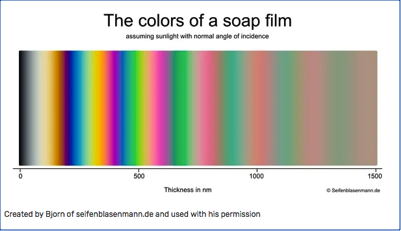


Did you know that each color in a bubble represents the thickness of the bubble? See more here!
Dolphins and Bubbles


Louis Pearl creating with bubbles...
Me playing with bubbles...in 2020.

Thomas Altman is an amazing bubble artist and scientist. He loves experimenting with bubbles. Check out his FB page.

More Bubble Experiments and Fun to come!
Winter Bubble Science and Fun!


'Extremely Rare' Four-Rainbow Sighting Mesmerizes the Internet
Dec 13, 2023 at 1:58 PM EST
By Soo Kim
SEO Reporter
FOLLOW
An astonishing view of four rainbows has been spotted in the Langdales region of England's Lake District, a U.K. national park.
The rare sighting was captured in early November by Nigel Danson, a 52-year-old professional landscape photographer based in the county of Cheshire in Northwest England.
The photographer shared a viral video of the sighting in a November 7 post from his Instagram account @nigel.danson. He told Newsweek: "It is actually two double rainbows. The second set of rainbows is caused by a reflection off Lake Windermere and is an extremely rare phenomenon."
The rainbows lasted around 45 seconds, "as the rain was passing through quickly," he said.
"I have seen many double rainbows...but [it was my] first time seeing four rainbows," Danson added.


Teaching science and making it fun since 1981
Thomas Altman is a friend of mine! We both live in New York State. Thomas is an amazing scientist and lover of bubbles. Inventor, Christian, fun guy all describe him. Check out his website!

Learn about very, very old bubbles...


A Guy at Bubble Magic!
Tom Noddy's very modest description of himself on Facebook

61,160 views Sep 28, 2017 Quantum Physics
Why are soap bubbles rainbow colored? Iridescence explained both by wave theory and QED (quantum electrodynamics). Dr Thomas Altman of Altman Science, who is a friend of mine, says this video has good content.
This is Jade. She's an Aussie with a Bachelor's degree in Applied Physics. After three years and over 100 lab sessions, She realized she's terrible at experiments. Now she makes physics and maths videos on YouTube :) Check out her channel and subscribe if you like:
Want to know more? Here's where she found info for this video:
Wave stuff
http://www.exploratorium.edu/ronh/bub...
http://www.vias.org/physics/example_6...
http://soapbubble.dk/english/science/...
Bryan Rolfe got distracted while working on a high-speed photography project and became interested in thin-film interference, so he thought I'd make short video about it!
If you're wondering why he haven't posted any videos in a while, he explains. A little over a year ago, He quit his job, and started sailing around the world on a small sailboat. As such, making and posting science videos has been all but impossible. However, he have found some time recently, and is now excited to be able to produce a few videos with it. Enjoy!